Back-of-the-Envelope Estimation for System Design Interviews: The 10⁵ Trick
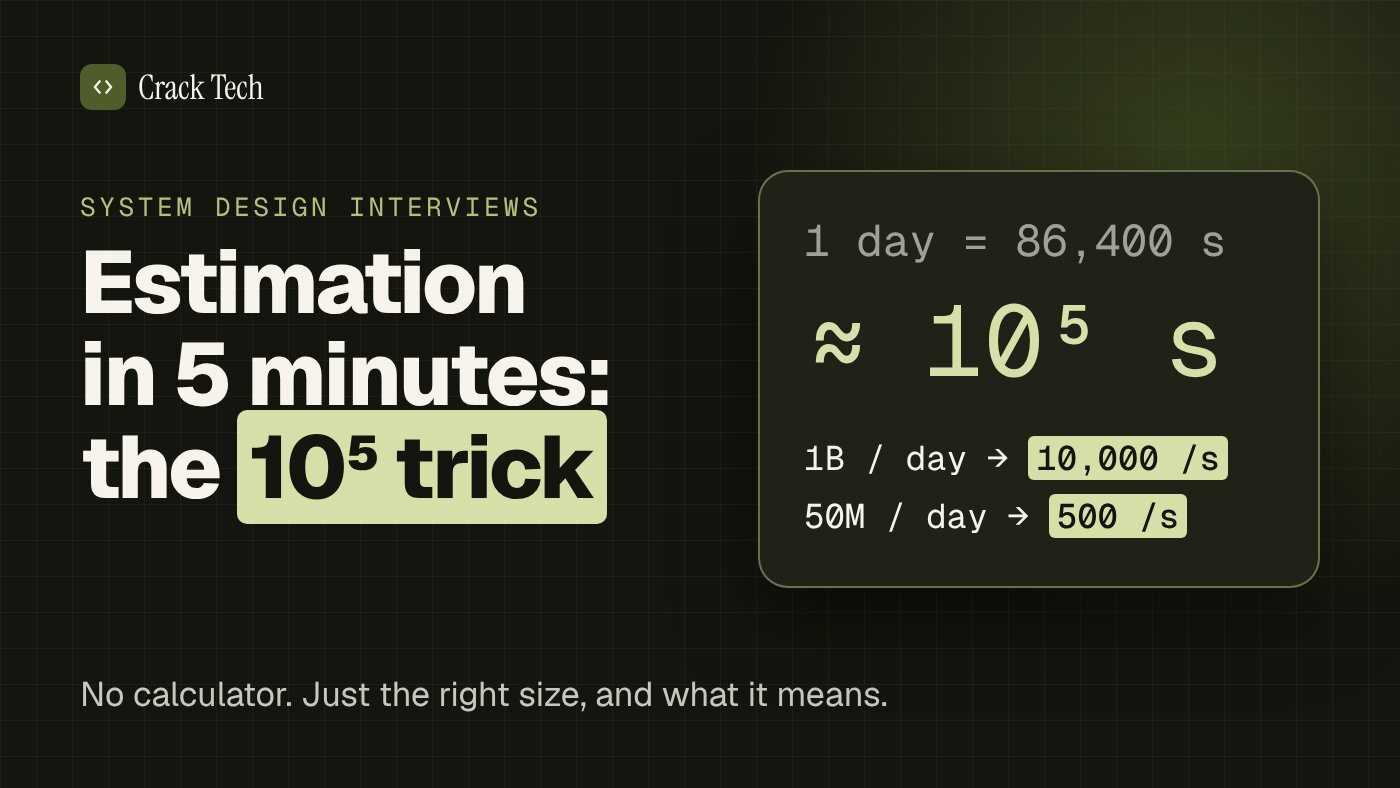
Most candidates either skip estimations or spend ten minutes multiplying huge numbers and lose track of what they're calculating. Interviewers don't want exact numbers. They want the right size, and they want to see it change the design.
The article gives three things to remember, a five-line template, a two-minute worked example for Google Calendar, and a table that turns the numbers into design decisions, with a one-page cheat sheet at the end.
Watch the walkthrough
The worked example from the Google Calendar walkthrough. It starts at the estimation chapter (2:30).
Key takeaways
- A day has 86,400 seconds. Round it to 10⁵, and any “per day” number becomes “per second” by dropping five zeros.
- Thousand, million, billion and trillion line up with KB, MB, GB and TB, so you add powers of ten instead of multiplying long numbers.
- Write five lines: users, actions per day, per second, peak (2–3 times the average) and storage for a year.
- Then say what the numbers mean: “Reads are 15 times writes, so I'll cache and shape the data for reads.”
- Round everything, design for the peak, write your assumptions down, and never leave a number unused.
Read the full article on Medium →
6 min read. Opens in a new tab.
Preparing for interviews?
Talk through where you stand and what to work on next.
Book a free 15-min call